Thibault Montoya builds the AI systems he talks about — agents, RAG, cloned voices in production — and runs them live on stage. The keynote resets what your organization considers normal performance.
The pivot equation. What took a team a week now takes a day — same effort, same headcount. 91% of companies use AI; 74% of the value is captured by 20% of organizations: the ones that steer, not the ones that endure. This talk resets the room's definition of normal performance — then shows, live, what the new normal looks like.
The biggest AI risk in the room is not the technology — it is the comfort of waiting. Your teams are not behind on AI; they are waiting to be told what is expected of them. The implicit contract between leaders, control functions, managers and teams is rewritten on stage, one floor at a time.
The practitioner's talk. The secret of AI is not the model — it is the loop: absorb, reason, act, measure, correct. Built live from real production systems: a voice cloned from 30 seconds of audio, an agent that reads three contracts and delivers a synthesis, a mail bot answering the room's questions in five seconds.
Most AI speakers show slides.
This one ships.
30 seconds of an executive's voice recorded in the room — with consent — becomes 3 minutes of generated speech. The audience compares. The room goes quiet.
An autonomous agent reads three contracts and delivers a comparative synthesis while the audience watches it reason, step by step.
A production mail bot built on 487 business knowledge cards answers questions from the audience in five seconds — the same system evaluated against experienced human advisers.
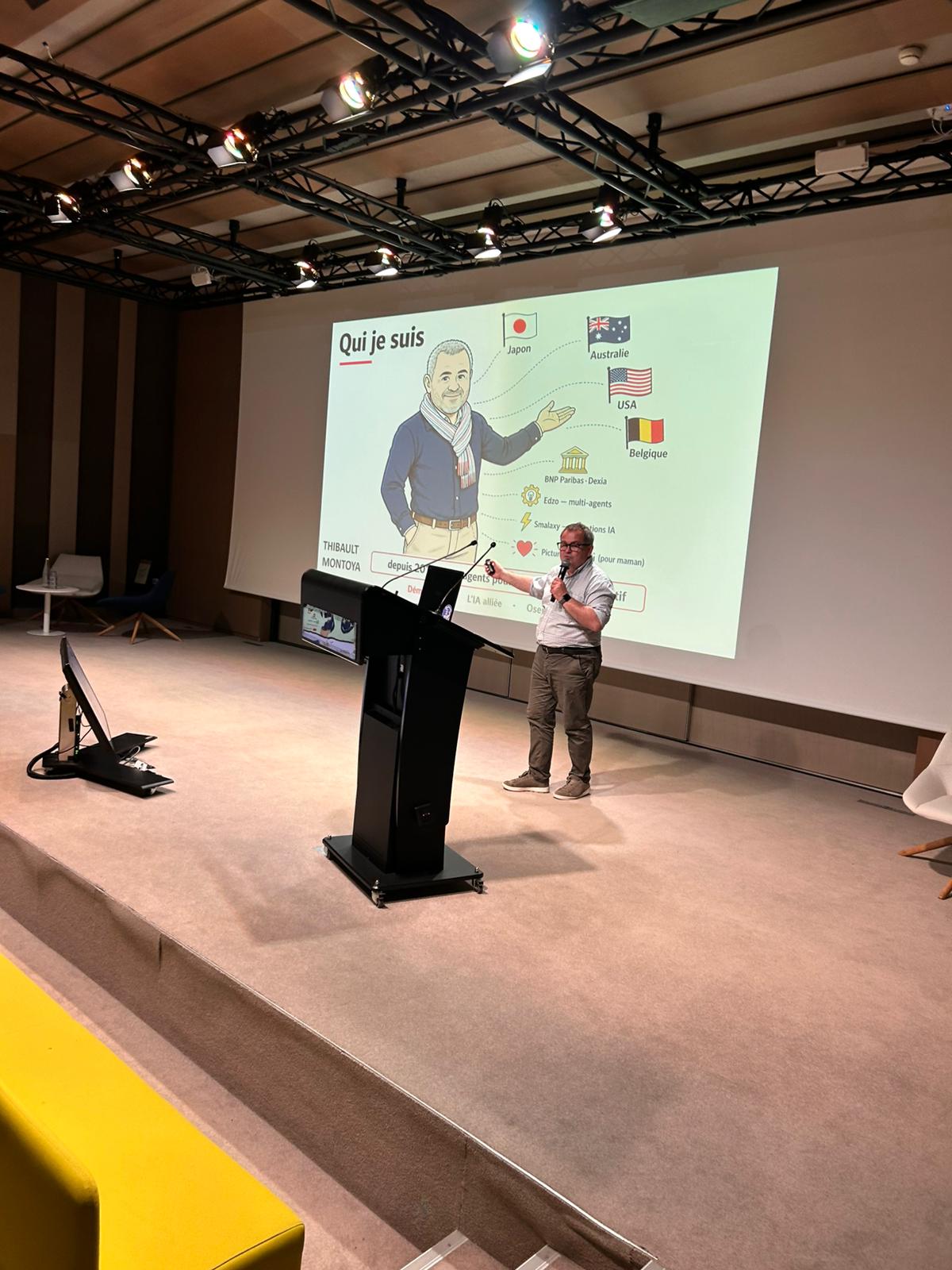
Thibault Montoya is the founder of Smalaxy and an AI keynote speaker who ships what he shows. After 20 years in international banking (BNP Paribas, Dexia — Japan, Australia, the US, Belgium), he now runs AI agents in production for enterprise clients: mail bots answering from 487 business knowledge cards, multi-agent pipelines, cloned-voice systems.
His framework, the Triple Unlock, names the three human locks that keep AI out of organizations — control functions that must loosen without losing the frame, managers who must learn what they can now demand, teams who must do — and the obligation underneath: keep training the young.
Prefer email? [email protected]